What a Finished Fishers Blind Install Should Look Like

Most blinds and shades don't die. They develop one specific fault in one specific part, and the rest of the unit is fine. A tilt gear strips. A cord lock stops holding. A clutch slips under load. A battery wand runs down and nobody thinks to check it. Knowing which failure you actually have is most of the job, so here is what breaks on a Fishers window covering and what each symptom is telling you.
Finished is a checklist, not a feeling
Ask three installers what a good job looks like and you will get three answers, but the measurable version isn't really in dispute. These are the things we check before calling any window covering in a Fishers home done, whether it's new or repaired.
- The bottom rail sits level to the eye, and the headrail is level in its brackets. On an out of square opening those two can fight each other, and the fix is a conversation rather than a shim jammed in and forgotten.
- The light gaps match. If there is a quarter inch of daylight on the left, there should be a quarter inch on the right. Uneven gaps mean the shade isn't centered in the opening.
- Full travel. The shade goes all the way up and all the way down and stops where it should, without hitting a bracket or stalling halfway.
- One hand operation. Lifting shouldn't take a wrestling match. If it does, the spring tension, the clutch class, the mounting, or the size of the shade is wrong.
- Room consistency. Bottom rails line up across adjacent windows when the shades are down. Headrails line up when they're up. Wands are the same length and hang on the same side.
- Hardware finished. Valance returns are on, corners are tight, clips are hidden, and no screw heads are staring at you.
- Cord safety. Any chain tensioner is fastened to the wall or frame, and there are no accessible loops left hanging.
- The site is clean. No pencil marks on the trim, no drywall dust on the sill, no offcuts behind the sofa, and the packaging is gone.
The repairs that come from a rushed install
A lot of what gets called a product failure started life as a shortcut. Brackets driven into drywall with no anchor loosen and let the headrail tip. A racked cordless shade that was never squared up runs crooked from day one and wears its lift system unevenly. A cord dragging over the edge of a bracket instead of running through its guide will shred in a fraction of its normal life. A tilt gear stripped in the first month usually means somebody forced it past the stop while showing the homeowner how it worked.
This is the argument for the walkthrough at the end. Two minutes of showing someone how far a tilt is supposed to go, and which direction the chain runs, prevents a service call in Fishers six months later.
Why this matters more than the product you picked
Custom window coverings measured and installed run roughly $250 to $2,600 a window nationally, and stock product runs roughly $60 to $600. You can spend at the top of that range and end up with a room that looks wrong because the bottom rails don't line up and one shade hangs half an inch low. You can also spend modestly and have a room look right because everything is level and consistent. The install and the finish work carry more of the result than the price of the fabric does, which is worth remembering when you compare two quotes on a Fishers, IN house. Ask what the finish standard is, and ask who is doing the work.
Repair is usually the cheaper answer, and sometimes it is the wrong one. Fabric that has gone brittle on the sun side isn't repairable. A discontinued headrail with no parts left isn't either. Fishers Window Treatments will tell you which side of that line your window covering is on before anything gets ordered. We are insured and insured and we work from a written scope. Reach us at (317) 863-9966.
What done looks like, product by product
Horizontal blinds
Slats close in both directions without a gap at the top, and the tilt stops before the gear does. The lift cords are even so the blind comes up flat rather than at an angle. On a door mounted blind, hold down brackets are installed at the bottom rail. Without them the blind swings and beats itself against the door every time it closes.
Roller shades
The tube is dead level, because a roller shade is unforgiving about this. If the tube tilts even slightly, the fabric telescopes, meaning it walks toward one end a little more with every cycle until it rubs the bracket. Roll direction should also match what you asked for. A regular roll puts the fabric closer to the glass, a reverse roll brings it forward over a deep sill or a handle.
Cellular shades
Cells are crisp and uncrushed, and the shade raises evenly rather than racking to one corner. On a top down bottom up unit, both rails sit parallel and move independently without dragging. If the shade was ordered with side channels, the edges run inside them cleanly with no catching.
Shutters
Panels close without rubbing the frame and latch positively. The reveal around each panel is even top to bottom, which is what the frame was installed square to achieve. Louvers hold whatever angle you set them to and move together across the whole panel. Divider rails line up from panel to panel across a wide opening.
Motorized shades
Upper and lower travel limits are set precisely, not approximately. Every shade in a group moves together instead of arriving a second apart. Scenes have names a person can understand rather than factory defaults. And the install date is written somewhere on or near the battery wand, because a year from now that note is the difference between a service call and a battery change.
Frequently Asked Questions
Can my old corded blinds be converted to cordless?
Sometimes, and it's worth doing the arithmetic first. Conversion kits exist for some horizontal blinds and some roller systems. By the time you buy the kit and pay for the labor, a new cordless shade in the stock range is often better value and will operate more smoothly because it was engineered that way. Conversion earns its keep on a large custom unit in an unusual opening that would be expensive to reproduce. ANSI/WCMA A100.1-2022 is the product standard behind the shift toward cordless.
Why does one slat on my blind hang lower than the rest?
A ladder rung has broken. The ladder strings run down both faces of the slats with small horizontal rungs between them, and each slat rests on a pair of those rungs. When one snaps, that slat drops and tilts out of line with its neighbors while every other slat behaves normally. New lift cord won't fix it, because the lift cord isn't what was holding that slat. The repair is replacing the ladder string or ladder tape, which is usually done at the same time as a restring.
My roller shade fabric keeps drifting toward one side. Is it broken?
Probably not. That is telescoping, and it almost always means the tube isn't level. A roller tube that tilts even slightly will walk the fabric a little further toward the low end on every cycle until it rubs a bracket. The fix is taking the brackets off and remounting them level, then re rolling the fabric square onto the tube. Occasionally the fabric was rolled on crooked at the factory, which is a warranty conversation rather than a repair.
How can I tell whether an install was done properly?
Look at four things. The bottom rail should sit level to your eye, the light gaps on the left and right should match, the shade should travel fully in both directions without stalling, and adjacent windows in the same room should line up with each other. Then check the details. Chain tensioners fastened to the wall, hold down brackets on any door mounted blind, valance returns installed, and no pencil marks left on the trim. A good installer also shows you how far the tilt is meant to travel.
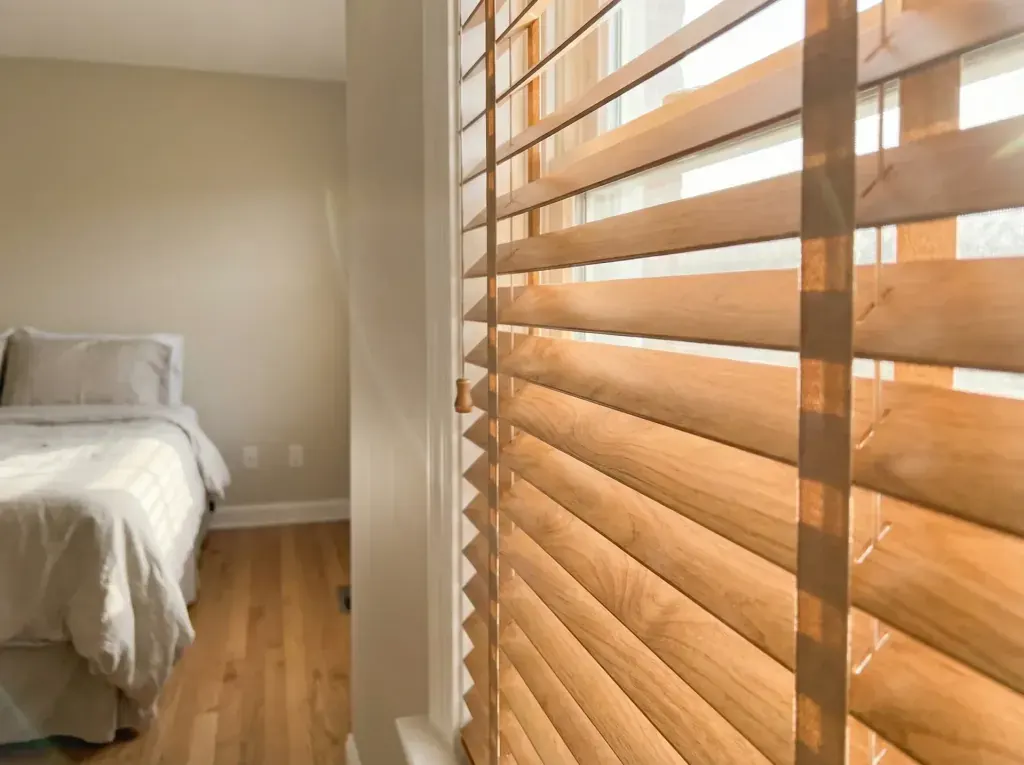 Wood Blind Pricing in Fishers: Stock Versus Custom Cost
 Plantation Shutters in Fishers: Measuring and Spec Guide
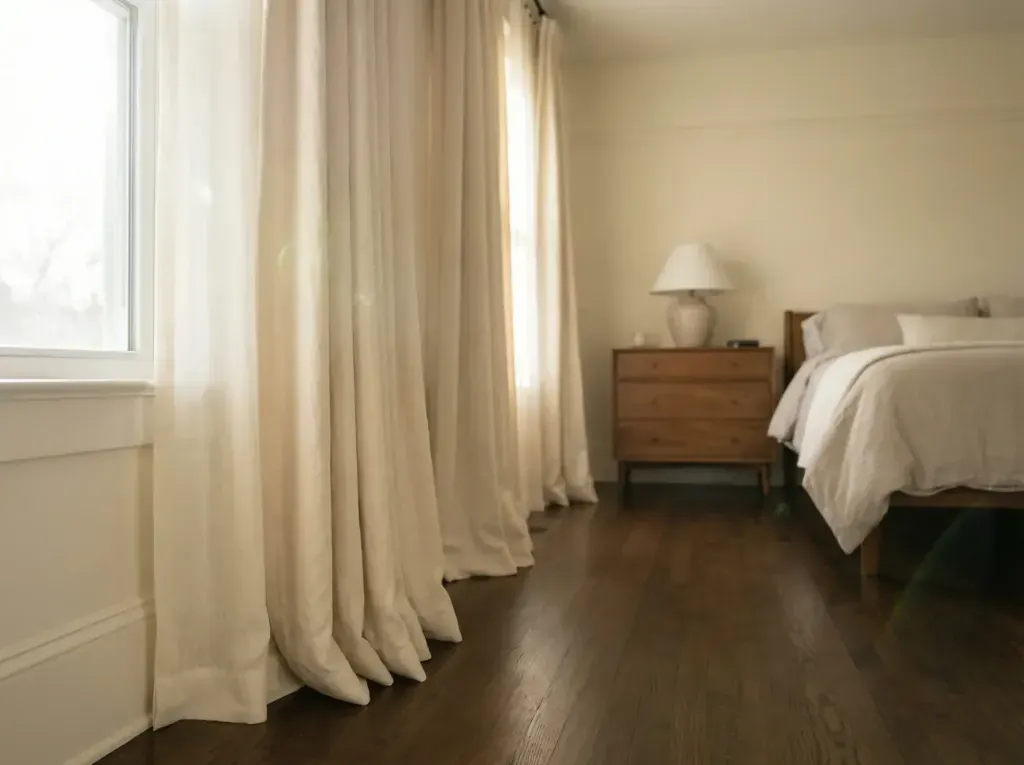 How Custom Drapery Gets Measured and Made Right in Fishers