Panel Track Blinds

Panel Track Blinds Serving Fishers, IN

Wide glass in sliding panels, with the stack measured first

Call (317) 863-9966Get Free Quote
Quick Answer

This section covers what the product does well, where it struggles, and what it costs to own over time rather than just to buy. All three matter on a purchase you'll live with for years.

  • Service: Panel Track Blinds for Fishers homeowners
  • Service area: Fishers, IN and surrounding areas
  • For a new order, plan on a measure appointment, then two to five weeks of fabrication, then an install visit. For a broken tilt gear or a dead battery, it's usually a single short visit and no waiting.
  • Insured and bonded
  • Serving Fishers, IN since 2008
Panel Track Blinds Services

Expert Panel Track Blinds for Fishers Homes

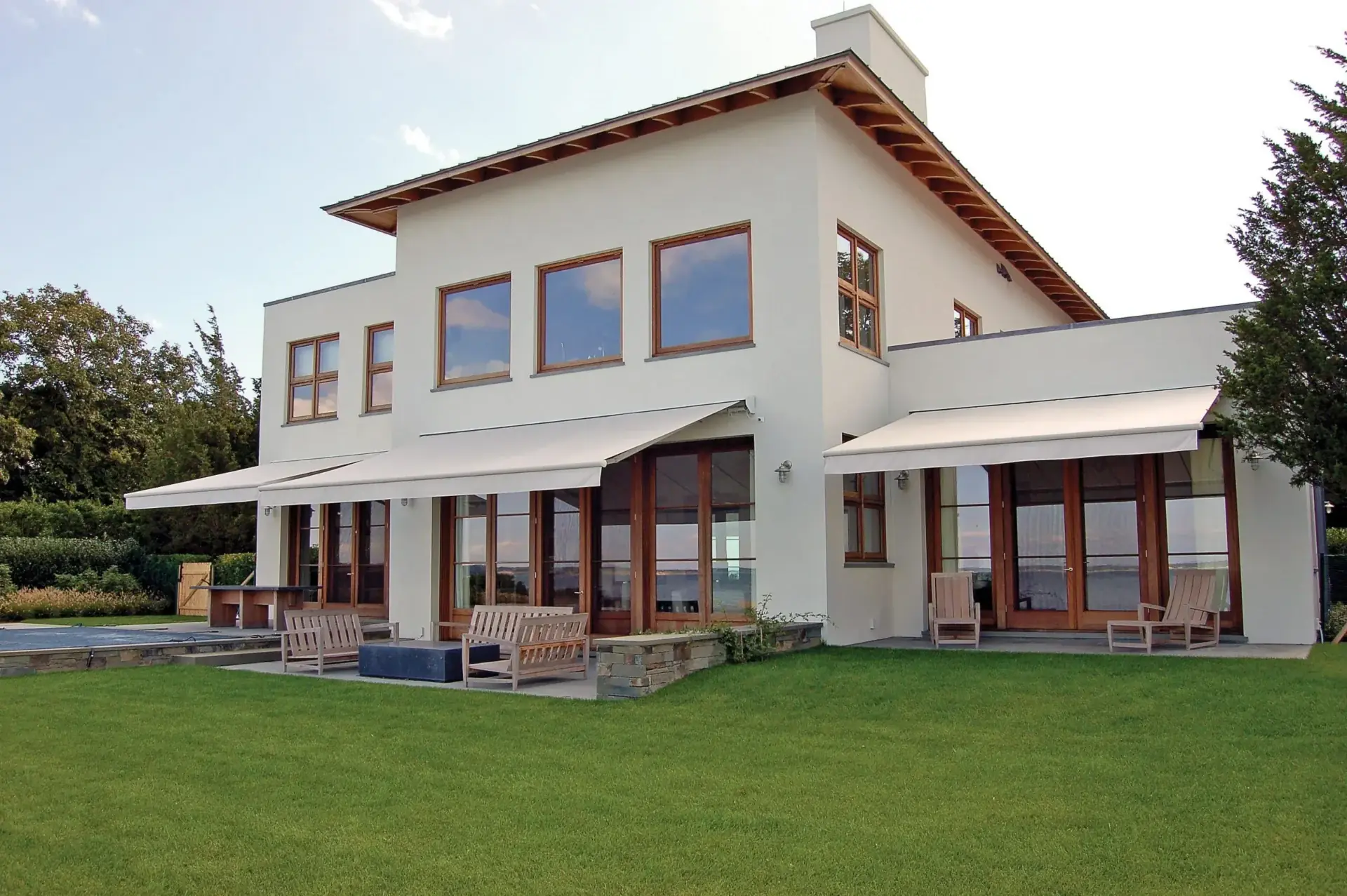
Panel tracks earn their place on the widest openings in the city, and Fishers puts those in two very different rooms. Springs of Cambridge runs 446 houses from 3,409 to 18,437 square feet on streets named Mariner, Coastline and Barnegat, 90 percent of them two story, with the main living space and the primary bedroom aimed at the reservoir. The lake elevation there is a run of door wall and fixed units rather than a window. Then the Nickel Plate District, where the individually parcelled homes were built between 2018 and 2025 on Citywalk, Panorama and Skyterrace, puts floor to ceiling street facing glass on a public sidewalk with no lawn in between.

The number to ask about first is stack depth. Panels don't roll or fold, they slide behind one another, so an open system is a solid block of stacked material standing at one end of the track. Four panels stack deeper than three. A wide opening covered in eight panels can park close to a foot and a half of material, and that block sits over glass unless the track runs past the opening onto wall. Stack side matters as much: put it on the wrong end and it covers the part of the view you actually use, or lands in front of a door handle. We measure the wall beyond the opening before anybody counts panels, and on a Nickel Plate District corner unit there isn't any.

When to Call

Signs You Need Panel Track Blinds

If you notice any of these in your Fishers home, it is worth booking a measure. None of it is urgent, and none of it fixes itself either.

A wall of glass has nothing on it at all

The old track drags at one end of a long run

Vertical vanes look dated on a modern opening

The front panel rubs the door lever every time

Fabric panels fade unevenly where the sun lands

Afternoon glare crosses a whole living space

An open plan needs a soft divider, not a wall

Drapery would eat floor space this room doesn't have

The slider treatment stacks over the door handle

Panels on the old track sag at the bottom edge

Our Process

How Fishers Window Treatments Handles Panel Track Blinds

Every job follows the same five-step process. Transparent, thorough, and done right the first time.

1

Written contract before ordering

2

Built to your sizes, two to five weeks

3

Fabric family narrowed before color

4

Seam positions laid out against the view

5

Track model recorded for future panels

Real Project Photos

Panel Track Blinds in Fishers

Photographs from real panel track blinds jobs completed by our crew in Fishers and surrounding areas.
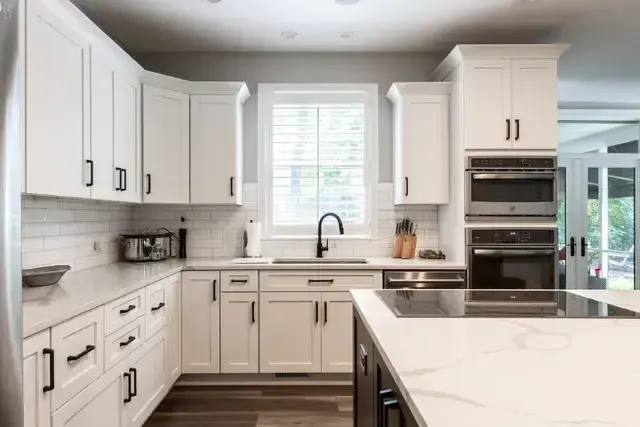
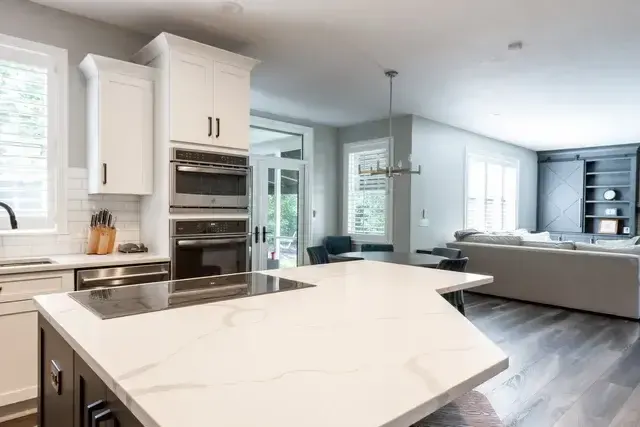
Custom shades measured and installed in FishersPlantation shutters fitted to a Fishers windowCellular shades in a Fishers living room
Scope of Work

What Panel Track Blinds Includes

Every Fishers job is documented item by item. Here is what the crew covers.

Stack depth calculated at the measure from the panel count, not estimated after the track arrives

Stack side agreed with you standing at the opening, one way to the left, one way to the right, or split to both ends

Channel count set against the opening width, since every channel adds a panel and every panel adds depth to the stack

Panel width and the overlap between panels worked out so the closed run covers the glass with nothing gapping

Track length extended past the trim on an outside mount so the stack lands on the wall rather than over the glass

Projection from the wall measured against handles, cranks and anything else living in or beside the opening

Finished width and height taken at three points each with a diagonal check, because a long track shows a slope immediately

Header substrate confirmed ahead of install day, since a loaded multi-channel track is heavier than it looks

Floor clearance set so the bottom weight bar sits clear of carpet, tile and any transition

Fabric chosen by what the opening needs, from an open solar weave with a stated openness factor to a room darkening face

Openness factor shown against your own glass rather than described, since the number means little until you see it

Woven wood panels sampled in your daylight where texture matters more than opacity

Draw side and control type settled per opening, wand or cord, with a tensioner fastened wherever a loop is used

Cord access on any corded draw specified to conform to ANSI/WCMA A100.1-2022

Motorized draw priced where a wide track would otherwise get drawn once and left alone

Panel attachment noted so you know which panels come off for cleaning and how they go back

A written contract covering scope, dates and the total price, per IC 24-5-11 on residential jobs over $150

Every panel drawn across the full track twice on install day so the carriers run without catching

Pricing

What Panel Track Blinds Cost in Fishers

Custom-fabricated window coverings run roughly $250 to $2,600 per opening in published national figures, with motorization adding roughly $300 to $1,500 per window installed. Those are national category ranges and they don't describe any specific opening in Fishers. Panel track is priced by the track and by the number of panels rather than by square footage alone, so a two-panel run on a 6 foot opening is modest and a five-panel run across a wall of glass is not. Fabric moves the number next: a plain light filtering panel is the floor, a woven wood or a room darkening face sits higher. The headrail itself is the part people underestimate, because a multi-channel track carrying wide panels is real hardware. Fishers Window Treatments quotes from the measured opening across Hamilton County.

By Product

How Panel Track Blinds Differ by Product

Every product in this trade behaves differently in a room. Here is what that means for this work.

Multi-channel headrail: The track itself, built with two, three, four or five channels depending on how many panels have to pass each other. The channel count is the single decision that sets both how the run behaves and how deep the stack ends up.

Panel width and overlap: Panels usually run somewhere between 18 and 24 inches wide, and each one overlaps its neighbor so the closed run reads as a continuous face. We do that arithmetic against your finished width instead of dividing by a round number.

One-way stack: Every panel gathers at a single end. It gives you the whole opening clear in one motion, and it puts the deepest stack you can build at that end, which is fine over a fixed panel and irritating in front of a door.

Split stack: Panels part in the middle and gather at both ends, which halves the depth at each side and looks balanced from the yard. It suits a wide opening with a walkway in the middle, and it needs an even panel count to look right.

Solar screen panels: An open weave with a published openness factor, so the panel cuts glare while the view survives. On a west wall this is the version people keep using, because the room gets comfortable without going dim in the middle of the afternoon.

Room darkening panels: A dense face that stops most light through the fabric itself. It gets a media room or a bedroom genuinely dim, and it doesn't seal, because panel edges and the track above them are still open by design.

Woven wood panels: Natural reed, bamboo or grass mounted as flat panels rather than as a rolling shade. The texture reads beautifully across a wide opening, and like every natural weave it passes light, so a liner comes into the conversation early.

Sheer panels: A translucent face that softens a view without closing it. It's what goes on a garden window wall or in front of drapery, and it does very little for privacy after dark once the lamps come on inside.

Hook-and-loop panel attachment: Most panels attach to their carriers with hook-and-loop tape, which means one panel comes off for cleaning or replacement without dismantling the track. It also means the panel goes back on straight only if you line it up carefully.

Motorized draw: A motor pulling the lead carrier across the track from a remote or a keypad. On a wide run it changes whether the treatment gets used daily. Plan on batteries as a recurring cost, since Hunter Douglas states PowerView life is about one year.

Common Questions

Panel Track Blinds FAQ

Questions we hear most often from Fishers homeowners considering panel track blinds.

Fewer panels means wider individual panels and a shallower stack, though each panel gets heavier and needs more track to clear the opening. More panels slide more easily and stack deeper. On a Springs of Cambridge lake elevation running the width of a great room, we usually land on wider panels and extend the track onto the wall, because there's structure to mount into and the point is keeping the water in view. On a Nickel Plate District unit where the wall beside the glass is a party wall or a corner, the track can't run anywhere and the panel count comes down instead.
Over the glass, and there's no way around it. That's the standard condition in the 2018 to 2025 attached product downtown and at Parkside Towns at Saxony, where units carry corner glass and party walls take the sides. Two things help. Split the track so half the panels stack left and half stack right, which halves the depth at each end. Or accept a partial cover and choose the end that costs you the least view. What we won't do is quote a panel count that looks good on paper and then park eighteen inches of material across the best part of your window.
Different look, different failure profile. Verticals hang individual vanes from carriers, and those carriers are the wear point, particularly on a west facing rear door with no mature canopy in front of it. Panels ride a track with fewer moving parts and no vanes to warp or spin. What panels give up is the tilt: verticals rotate to let light in without opening, while panels only slide. If you want partial light with the opening still covered, verticals do something panels can't. If you want a clean modern face across a wide opening, panels win easily.
The lower run, yes, and this city asks the question constantly. Fishers records 73.8 percent of its single family parcels at two stories or more, so a great room glass wall is a recurring job rather than an occasional one. A panel track works well across the portion at normal ceiling height. It doesn't solve the upper part of a two story wall, because the track has to be reachable to slide and nobody is sliding a panel at eighteen feet. Those upper units want a motorized roller or cellular shade, with the panel track handling the level you walk past.
Most of what you'd put on a roller, which is the quiet strength of the system. Solar fabric at 1, 3, 5 or 10 percent openness for a west or lake elevation. Room darkening for a bedroom wall. Woven natural material where the room needs texture. You can also mix within one track, running a solar panel beside a room darkening one so the same opening does two jobs depending which panels you slide across. The limit is weight: a heavy fabric on a very wide panel loads its carrier and slides less sweetly, so we size the panel to the fabric rather than the reverse.
The carriers and the alignment, in that order, and neither is dramatic. Each panel hangs from a carrier in the track, and a carrier running dry or carrying too much weight starts to drag. Track debris does the same thing, which matters more on a door opening used daily than on a fixed window. The other issue is the bottom: panels are weighted along the hem to hang plumb, and a panel caught by a door or a pet can pick up a permanent lean. Individual panels and individual carriers are both replaceable, so this is normally a service call rather than a reorder.
It's a set of wide flat fabric panels hanging from a headrail with several channels in it, so each panel can slide past the others and gather at one end. Think of it as a horizontal version of a shade rather than a vertical blind: nothing tilts, and the fabric hangs flat instead of as narrow vanes. On a wide Fishers opening it reads as four or five calm panels instead of forty vanes, which is most of why people ask for it.
Deeper than a vane stack, because every panel is a solid layer of fabric on its own carrier, and depth grows directly with the panel count. A five-channel track stacks noticeably deeper than a three. That stack has to live somewhere, and the honest options are over fixed glass, past the opening onto the wall, or split to both ends. We work out the depth at the measure and then decide where it lands, which is the single decision that makes people happy or unhappy with this product.
Whichever side costs you the least. On a patio door, off the operating panel. On a window wall, toward the end you look at the least, or split so both ends carry half. On an outside mount we can run the track past the trim so the stack sits on the wall and the glass stays clear when it's open. That last one is the version most people want once they see the depth, and it needs the track ordered longer than the opening.
It comes out of your finished width, not out of a preference. Panels generally run 18 to 24 inches wide, and each has to overlap its neighbors so the closed run has no daylight between the joints. We divide the opening so the panels land at a sensible width and the overlaps work, then check the resulting stack depth against where it has to sit. Sometimes the arithmetic pushes you from four panels to five, and that changes the stack, which is exactly why the two decisions get made together.
It can make it dim. Even with a room darkening fabric, this is a system of separate panels hanging from an open track, so light passes at the panel joints and above the fabric line. That's the format, not a fault. If a media room in Fishers has to be dark, the answer is a blackout shade in side channels, or a panel track layered in front of one. We put that in writing before you order rather than after you sit down to watch something.
Yes, and it's one of the better uses. A track across an opening between two rooms makes a soft divider you can push aside. A track over a closet opening replaces bi-fold doors that never ran straight. A track in front of shelving hides storage in a laundry or an office. The mounting is the same and the fabric choice changes, since a divider panel is about opacity and texture rather than about daylight.
One panel comes off and gets dealt with. Most systems attach the fabric to the carrier with hook-and-loop tape, so a single panel lifts away without touching the track or its neighbors. That's a real advantage over anything permanently mounted. Two cautions: reattach it carefully or it hangs a little off plumb, and if you're replacing rather than cleaning, dye lot matters, because a new panel woven this year may sit slightly off the four that have been in the window for two.
They shouldn't, and there's a specific reason why. Each panel carries a weight bar in a hem pocket at the bottom, which holds the fabric flat and stops it from swinging when the door beside it opens. On tall panels the bar matters more, and on very tall runs we'll talk about fabric weight, because a light fabric over a long drop moves more than people like. A panel that curls at the edge is usually a fabric that was too light for the drop.
Wide, which is why the product exists. Manufacturers publish limits by track and by channel count, and openings of 12 feet and beyond are ordinary work rather than exotic. The practical limits are the stack depth at the end of a very long run and the weight the header has to carry, which is why we confirm what the fastener lands in before install day. Past the published width, two tracks meeting in the middle with a split stack reads as one treatment.
Look and control, mostly. Vanes tilt, which gives you angle control and lets you keep the glass covered while turning the light, and they cost less. Panels don't tilt at all: they're open or they're closed, and the fabric does whatever the fabric does. What you get for that is a much calmer face across a big opening and no clatter, because there's nothing narrow hanging free. Rooms where the wall of glass is the feature usually end up with panels.
Outside mount most of the time, and depth is why. A multi-channel track needs real mounting room, more than a single roller bracket does, and few openings have it. Mounting above the opening also lets the track run long so the stack parks on the wall. Inside mount is possible in a deep opening and it looks tidy, and it means the stack sits inside the opening covering glass, plus the usual light down each side. We measure the depth and then tell you which one you actually have.
Yes, and on a wide opening it's worth the conversation. A motor pulls the lead carrier and the rest follow, so a 14 foot run of panels closes from a keypad rather than from a wand at one end. Installed motorization sits nationally at $300 to $1,500 per window. The recurring cost is batteries, and Hunter Douglas states PowerView battery life is about one year, which we put in writing before the order rather than mentioning at the handover.
They will if the track went up level, and that's on us. A long headrail exaggerates everything: a quarter inch of slope across 12 feet shows as a visible wedge at the bottom of the panels, and carriers on a track that isn't straight will drag at one end. We level the track rather than following the trim line, because trim in a settled Hamilton County house is often not level itself, and we run every panel across the full track twice before we leave.
Two to five weeks is the usual custom fabrication window. The track gets cut to your finished width and the panels get fabricated to the widths we worked out at the measure, so nothing here comes off a shelf. Woven wood panels tend to run longer than plain fabric ones. You'll have the fabrication window in writing along with the scope, the dates and the total price, which the Indiana Home Improvement Contract Act requires on residential work over $150.
Areas We Serve

Panel Track Blinds Across Fishers

We measure and install in every one of these Fishers neighborhoods. Each has its own page with the build eras, window conditions and mounting notes for that section.

Free In-Home Measure

Schedule Your Free In-Home Measure in Fishers

Contact Information

Reach Us Directly

Our team prioritizes scheduled measures and service calls, and books in-home measures during business hours.

Office
1417 Commerce Avenue, Indianapolis, IN 46201
Hours
Mon-Fri 8a-6p
Service Area
Fishers, IN and Surrounding Areas

Ready to Book Your Measure?

Call us to set up an in-home measure, or to ask about a treatment that has stopped working. We will talk it through on the phone first.

Service area

Serving Fishers and the surrounding area

Call NowGet Quote