Roman Shades

Roman Shades in Fishers, IN With Fishers Window Treatments

Folded fabric, with the stack height sized before ordering

Call (317) 863-9966Get Free Quote
Quick Answer

What follows covers the practical side of this service: how it's measured, what changes the price, how long fabrication takes and what maintenance it needs once it's hanging.

  • Service: Roman Shades for Fishers homeowners
  • Service area: Fishers, IN and surrounding areas
  • A restring, a new cord lock, a tilt mechanism or a dead motor battery gets handled far faster than a new order, because nothing has to be built. New custom work runs on the factory's two to five week clock.
  • Insured and bonded
  • Serving Fishers, IN since 2008
Roman Shades Services

Expert Roman Shades for Fishers Homes

Roman shades are fabric that folds rather than rolls, and they exist because some rooms want softness that a hard treatment can't give. Fishers rooms often need it more than most. The 2000 to 2019 production stock, 16,082 houses and 51.1% of the city, built great rooms with high ceilings, hard floors and a lot of drywall, and those rooms can read echoey and unfinished with nothing but a blind at each window. A pair of Roman shades changes the acoustics of a room as much as the look of it.

The technical decision is stack. When a Roman shade is raised, the folds gather at the top and occupy real height, and on a lined or interlined panel that stack is deeper than people expect. If the headrail is mounted inside the opening, the stack sits over the glass and takes daylight with it. We size the stack at the measure and, where it matters, mount the shade above the opening so the raised stack sits on the header rather than on the view.

Fold style is the other decision and it's more consequential than it sounds. Flat folds read tailored and modern. Relaxed folds carry a gentle curve at the bottom and suit a softer room. Hobbled folds keep permanent horizontal pleats even when the shade is down, which reads traditional and rich and uses considerably more fabric. London style is the most decorative of them. We look at your room and at what's already in it before we recommend one.

When to Call

Signs You Need Roman Shades

If you notice any of these in your Fishers home, it is worth booking a measure. None of it is urgent, and none of it fixes itself either.

The great room feels hard and echoes with nothing at the windows

A blind alone leaves the wall looking unfinished

You want fabric without the cost of full length drapery

The stack of an existing shade covers the top of the glass

A rectangular window sits under an arch you don't want treated

Sun has faded one panel and not the one beside it

The room needs texture that a roller can't give it

You want a shade that reads as furniture rather than hardware

Our Process

How Fishers Window Treatments Handles Roman Shades

Every job follows the same six-step process. Transparent, thorough, and done right the first time.

1

Read the room first

We look at what's already in the room before we open a fabric book. Floor covering, upholstery, the wall color and how much natural light arrives at what hour all narrow the choice faster than a catalog can. In an open 2000s Fishers plan we also look at what's visible from the room, because a great room, a breakfast area and a kitchen that see each other need to be treated as one decision.

2

Pick the fold style

Flat for a tailored modern look, relaxed for a softer curve at the bottom, hobbled for permanent horizontal pleats that read traditional, London for the most decorative option. Fold style changes yardage significantly, so it changes price. We show you photographs of each in a room of similar proportions rather than describing them, because the words mean very little until you see them.

3

Choose lining and interlining

An unlined Roman shade glows and shows the light through the fabric, which can be lovely and is useless for privacy. A lining gives body and evens the appearance from the street. An interlining adds a soft layer between face and lining that improves the hang and the insulation and gives the fold its weight. A blackout lining is available and comes with the usual edge leak caveat on an inside mount.

4

Measure and size the stack

Three widths, three heights, a diagonal and a depth check. Then we calculate stack height for your chosen fold and lining and tell you the number in inches. If that stack would sit over your glass on an inside mount, we say so and price mounting above the opening instead, which is usually the better answer in a Fishers room where the view or the daylight is the point.

5

Order the sight line together

Fabric is dyed in lots and lots vary, so every shade that will be seen at the same time gets ordered in one batch. In a Fishers open plan that's often more windows than the customer first assumed. We walk the sight lines with you and agree the batch before ordering, and if a room is being deferred we say plainly that a later match is a risk rather than a certainty.

6

Install and dress the folds

Brackets set and leveled, shade hung, then we dress the folds by hand so they sit evenly and hang the way the workroom intended rather than the way the box shaped them. A Roman shade that has been shipped folded needs this and doesn't settle by itself. We raise and lower it several times, check the folds return to the same place, and show you how to reset them if they wander.

Real Project Photos

Roman Shades in Fishers

Photographs from real roman shades jobs completed by our crew in Fishers and surrounding areas.
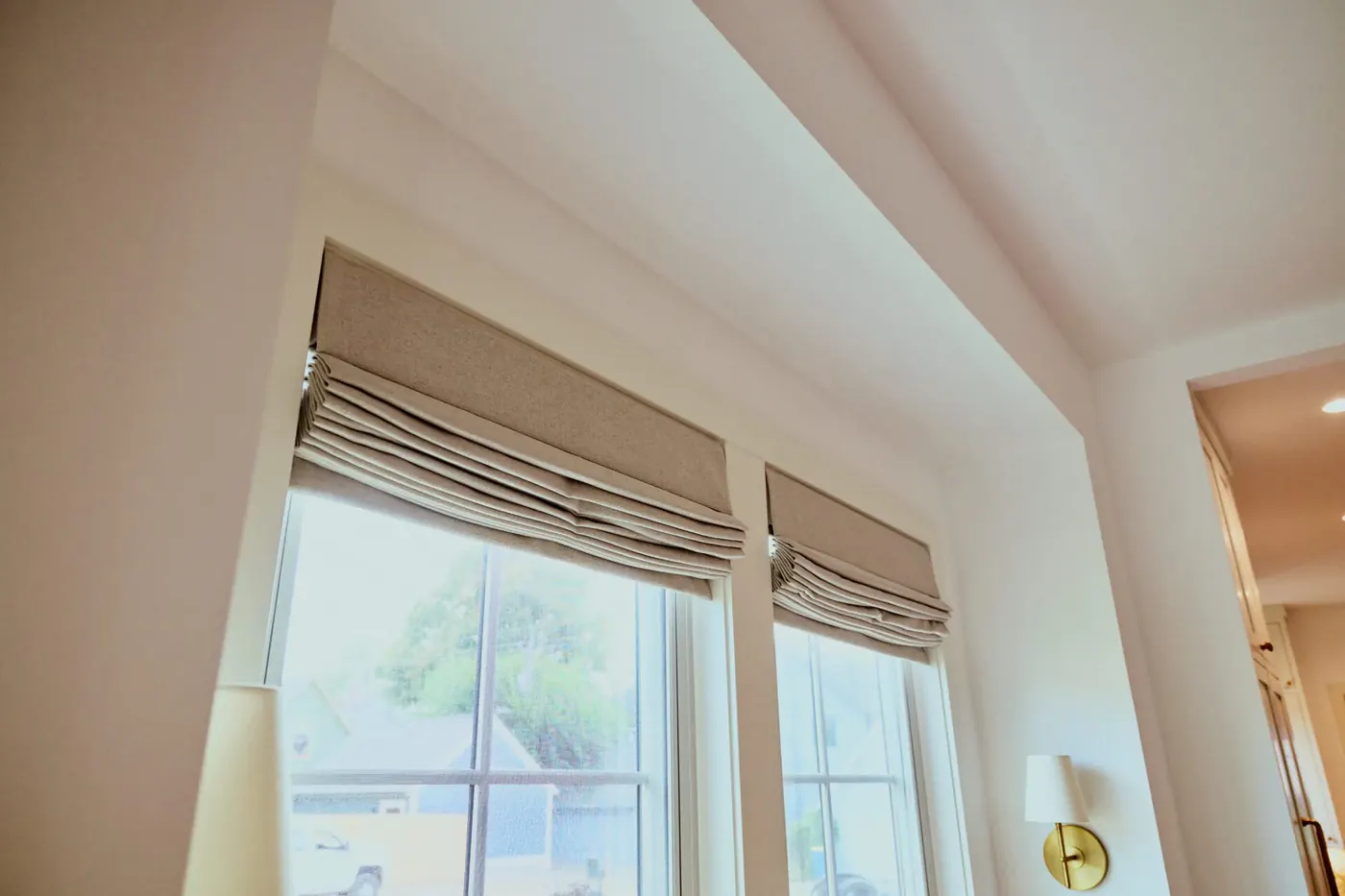
Custom shades measured and installed in Fishers
Scope of Work

What Roman Shades Includes

Every Fishers job is documented item by item. Here is what the crew covers.

Three widths and three heights taken at every opening, then a diagonal check so the shade hangs level

Mounting depth read at the top of the opening to see whether the stacked folds clear the trim on an inside mount

Stack height calculated from finished height, fold count and lining, then shown to you before anything is ordered

Outside mount height set above the opening wherever the stack would otherwise sit across the glass

Fold style specified room by room: flat, relaxed, hobbled or London

Fold count and fold depth written on the order so the bottom fold doesn't come up short

Lining specified per elevation, light filtering or room darkening or none, and stated in writing

Interlining added where the face fabric needs body or where the room wants weight and quiet

Pattern repeat measured so the motif lands at the same height on every shade in a room

Fabric run direction decided against the width, since a wide shade may need the goods turned

Ring rows and dowel pockets drawn to the fold spacing instead of a factory default

Lift chosen as cordless, a continuous cord loop with a tensioner, or a motor

Cord safety handled to ANSI/WCMA A100.1-2022, with cordless specified anywhere a child can reach

Mounting board wrapped in the face fabric where the board itself will show from the room

Return depth dimensioned on outside mounts so the sides close off against the wall

Brackets fastened into framing or into anchors rated for a lined shade's weight, not into bare drywall

Shades steamed on site so the creases from folding and shipping fall out of the cloth

Folds dressed by hand and the shade cycled a few times so every fold trains and breaks in the same place

Pricing

What Roman Shades Cost in Fishers

National category figures put stock shades at roughly $60 to $600 per window and custom-fabricated shades at roughly $250 to $2,600 per window. Those are national ranges published for a category, not a price for any address in Fishers, and Fishers Window Treatments quotes from a measure rather than an average. Romans usually sit in the upper part of that band, because what you're buying is yardage and sewing rather than cloth wrapped on a tube. Fabric moves the number first and it's sold by the yard, so a large pattern repeat adds cloth before anyone cuts. Lining and interlining come next. Then fold style, since a hobbled shade eats noticeably more fabric than a flat one of the same size. Two Hamilton County windows of identical size can land far apart on cloth alone.

By Product

How Roman Shades Differ by Product

Every product in this trade behaves differently in a room. Here is what that means for this work.

Flat Roman: One uninterrupted face of fabric when the shade is down, with folds appearing only as it rises. It shows a print or a weave better than any other style, and it's the one we specify in rooms that want a quiet, tailored line.

Relaxed Roman: Built without a dowel in the bottom fold, so the hem carries a soft curve instead of a straight line. It suits a kitchen window over a sink or a casual room, and it forgives a slightly unlevel opening better than a flat shade does.

Hobbled Roman: Permanent cascading folds stay stacked down the whole face whether the shade is up or down. It reads soft and traditional, it uses considerably more yardage, and it stacks much taller when raised. Plan the mount height around that.

London shade: Gathered at two points with soft tails falling at each side, usually hung as a stationary treatment or one that gets raised rarely. It's a decorative shade for a powder room, a stair landing or a window that never needs daily operation.

Dowel and ring construction: Rods sit in sewn pockets across the back and rings carry the lift cord. Pocket spacing sets fold depth, and drawing it against the finished height is how you avoid a runt fold at the bottom of an odd-height window.

Cotton sateen lining: The standard backing. It gives the shade body so folds hold their shape, it slows fading of the face fabric, and it puts the same neutral face toward the street from every window on an elevation.

Interlining: A soft flannel layer between face fabric and lining. It thickens the fold, quiets the room a little, adds real insulating bulk at a cold January window, and it turns a thin decorator fabric into a shade with weight.

Cordless lift: A spring-assisted mechanism raises and lowers the shade by hand with no loop hanging anywhere. It's the default in nurseries and any room a child uses, and on a lined Roman it wants correct spring sizing for the actual fabric weight.

Motorized Roman: A battery or hardwired motor lifts the shade on a remote or a schedule. It earns its keep on a shade above a stair, over a sink or on a tall window, and battery wands need changing about once a year.

Wrapped mounting board: The board the shade staples to, covered in the face fabric so it disappears when the shade is mounted outside the opening. Without it you see raw lumber above the shade from anywhere in the room.

Light Control

See What Each Fabric Does To The Light

Pick a fabric below and the window updates. It's a drawing rather than a photograph, so read it as a rough guide to what each family does in a Fishers room, and to what it doesn't do.

Fabric type

Sheer, 10 percent openness

Ten percent of the weave is open, so you keep the view and most of the daylight. Glare drops a little. After dark, once your lamps are on, someone outside can read shapes through it, which is why this belongs on a view window rather than a bedroom.

Openness factor is printed on the fabric card, so you can compare one line against another before you order anything.

Keeps the viewNot private after dark

Solar, 5 percent openness

The usual pick for a west window or a covered porch. You can still read the yard through it, glare comes down noticeably, and the fabric intercepts a good share of the sun before it reaches you at four in the afternoon.

It also cuts the UV landing on floors and furniture. NFRC puts UV at roughly 40 to 60 percent of fading damage, so this slows fading rather than stopping it.

View and glare controlSlows fading

Solar, 3 percent openness

A tighter weave. The room goes dimmer and the view drops back to an outline. Choose it where the sun is the problem and the view is second, which around here usually means a west wall in July. That's a common call on this side of Indianapolis.

Openness affects how much you see out, not how private you are. A 3 percent fabric still shows silhouettes at night.

View becomes an outlineStrong glare control

Solar, 1 percent openness

Close to a solid fabric with a little view left in it. This is the strongest glare control in the solar family.

The trade is that it darkens the room on a gray January day too. Indianapolis averages a January high near 36F and the light is flat, so think about how the room reads in both seasons before you commit.

Darkest solar optionDim on gray days

Light filtering

No view through it. Daylight comes through the face diffused, so the room stays bright without a hot spot across the television or the kitchen island. This is the default for living spaces.

It isn't private in reverse at night. With the lamps on and the sun down, silhouettes still show.

No view through itBright without the glare

Room darkening

A denser fabric, usually with a liner behind it. Most of the light coming through the face is gone.

Light still arrives around the edges on an inside mount, so a room darkening shade gives you a dim room rather than a dark one. If someone in the house sleeps during the day, say so at the measure and we'll scope it differently.

Dim, not darkEdges stay bright

Blackout

The fabric itself passes essentially no light. What you'll still see is the perimeter. Lutron publishes an inside-mount light gap of about 3/4 inch per side on its Roller 20 and 64 shades, along with a standard factory deduction of 1/16 inch per side, and shades over 120 inches tall or past a 4:1 height-to-width ratio get larger gaps than that.

So if you need a genuinely dark bedroom, that gap has to be dealt with on purpose, either with side channels or by going outside mount. We tell you which one your opening can carry while we're still standing in the room.

Dark facePerimeter needs a plan

Openness factor is a measured fabric spec, so you can compare it line to line. The category names are not measured. One maker's room darkening can behave like another maker's light filtering, which is why the sample books come to the measure and get opened in the room they're going in, at the hour that room has the problem.

Common Questions

Roman Shades FAQ

Questions we hear most often from Fishers homeowners considering roman shades.

More than most people expect, and the number depends on your fold style and lining. A flat fold on a light unlined fabric stacks tightly. A hobbled fold on an interlined face fabric stacks a great deal deeper because there's far more material and it's heavier. On a tall Fishers window the stack can be a foot or more. That's why we calculate it at the measure and give you the figure, and why on a window where the view or the daylight matters we usually mount the shade above the opening so the raised stack sits on the header.
Flat folds read tailored and suit the cleaner elevations of the 2019 onward Fishers stock and the downtown units. Relaxed folds have a gentle curve along the bottom and soften a room without going traditional. Hobbled folds hold permanent horizontal pleats even when the shade is down, which reads rich and formal and uses noticeably more fabric, so it costs more. London style is the most decorative. There's no technically correct answer here. We show you each in photographs of rooms with similar ceiling heights, because the difference is impossible to describe usefully in words.
Usually not, and we would rather say so. A fabric shade in a room that runs a shower twice a day is sitting in humidity, and the bottom of the panel is the part that gets it worst. Over time that means the hem holds moisture, and in a Fishers winter it gets compounded by condensation on the glass wicking into the fabric on an inside mount. The visible result is dark spotting along the bottom and a musty smell. Composite shutters or faux wood blinds are the right products for a wet room, and a Roman shade belongs elsewhere in the house.
With a blackout lining it blocks light through the fabric completely, and the edges still leak on an inside mount because they always do. There's an extra consideration on a Roman specifically: the folds themselves create small gaps where the fabric turns, and on a lined panel some light can enter around the rings and cords depending on construction. For a Fishers primary bedroom where dark actually matters, we usually pair a room darkening roller or cellular behind the Roman shade, which gives you the fabric look and a genuinely dark room.
It doesn't treat the arch, and that's often the right answer rather than a limitation. Half round and elliptical heads over front entries and foyers are close to standard on the 1995 to 2010 Fishers production elevations, and a great many of those arches are contributing very little light or heat. Treating the rectangular unit below the arch with a Roman shade and leaving the arch bare looks deliberate, keeps the architectural feature the builder paid for, and costs a great deal less than fabricating a custom arch treatment nobody will operate.
On a Roman shade, more visibly than on most products, because the folds mean some parts of the fabric are shaded by other parts. NFRC guidance puts ultraviolet at roughly 40 to 60 percent of fading damage, with visible light, heat and dye chemistry doing the rest, so a shade slows fading rather than preventing it. In practice, on a south or west Fishers window, the exposed faces of the folds age ahead of the parts that sit tucked. Keeping the shade in a consistent position makes this more pronounced, not less.
You can order one now. Matching it later is the risk. Fabric is dyed in lots, lots vary, and a Roman shade shows a dye difference more than a small blind does because you're looking at a large flat area of a single color. If two shades will ever be seen at the same time, order them together. In a Fishers open plan where a great room, a breakfast area and a kitchen all see each other, that's usually several windows, and we'll walk the sight lines with you before ordering.
Yes, with the right operation. Corded lift on a heavy interlined panel is workable but the cords take real load, and a continuous cord loop with a wall anchored chain tensioner is the better system on anything large. Cordless works well on lighter panels and less well on heavy ones, because the spring has to hold more weight. Motorized is the answer on tall windows and on anything used several times a day. In a Fishers family room we usually motorize the shades and leave the guest bedroom ones cordless.
More than most people picture, and this is the part nobody asks about until it's hanging. A raised Roman gathers into a stack of folded cloth at the top, and that stack has real depth. A lined shade on a tall window can take up a foot or more of height when it's all the way up. On an inside mount, that stack sits over the top of the glass all day. The fix is knowing the number before you order, which is why we calculate it at the measure and show it to you.
Start with the room rather than the catalog. A flat Roman is the cleanest and shows a pattern best, so it goes in rooms that want a tailored line. A relaxed shade has a soft curve in the hem and reads casual, which suits kitchens and cottage-style rooms. Hobbled keeps its folds all the way down and looks traditional, but it uses more cloth and stacks taller. A London shade is decorative and mostly stationary. We bring samples of the same fabric made three ways so you can see it rather than imagine it.
Inside looks cleaner and shows off your trim, but it needs depth, and the stack still lands over your glass when the shade is up. Outside mount is what we reach for when the view matters, because the board can go well above the opening and the whole stack sits on wall instead of window. Outside also closes off the light gaps at the sides. In a Fishers room with a view worth keeping, outside mount is usually the right call even though it covers a little trim.
A room darkening or blackout lining stops light coming through the cloth, and that's genuinely most of the light. What it can't do is stop light coming around the shade. An inside-mounted Roman leaves a gap at each side, and light walks straight through it. For a bedroom that has to be dark, you want an outside mount with generous overlap, or a blackout roller with side channels underneath and the Roman on top for looks. We'd rather say that now than after you've paid for lining.
Yes, and in most houses you should. Cordless lift uses a spring mechanism you operate by grabbing the hembar, and motorized removes the question entirely. ANSI/WCMA A100.1-2022 is the product safety standard this trade works to, and inner cords that aren't compliant are treated as a substantial product hazard under 16 CFR 1120.3. On a heavy lined shade the spring has to be sized to the actual fabric weight, so tell us about the lining before the order goes in, not after.
Wider than you'd think and narrower than you'd like. Fabric shades get heavy fast, and past a certain width the cloth starts to sag between the rings and the lift gets hard to work. On a wide opening we'll usually split it into two shades on one board, matched at the pattern so they read as a pair. That also keeps each shade at a weight a person can raise without a fight. The exact limit depends on the fabric and the lining, which is why we decide it at the window.
Because you're buying cloth by the yard and then paying someone to sew it. A shade that takes four yards of a mid-priced fabric and a shade that takes seven yards of an imported weave aren't in the same conversation, and the second one hasn't even reached the sewing table yet. Pattern repeat adds yardage on top, since motifs have to land at the same height across a room. Fold style adds more. We figure yardage during the quote so the number isn't a surprise on the order.
They will if the shade was built and dressed properly. Fold spacing is set by the dowel pockets and ring rows, so it's baked into the construction rather than something that drifts. What does go wrong is a shade that was never trained: it arrives folded flat from the factory, gets hung, and the shipping creases live in the wrong places forever. We steam on site, then dress each fold by hand and cycle the shade so the cloth learns where it bends.
In a kitchen, yes, with sense about placement. Fabric near a cooktop takes on grease and cooking smells, so we keep Romans on the window over the sink and off the window beside the range. In a full bathroom with a shower running daily, fabric holds damp and the folds can hold it longer. A poly shutter or a moisture-tolerant shade does better in that room. A powder room with no shower is fine, and a London shade there looks terrific.
Vacuum the face with a brush attachment a few times a year, working down the folds rather than across them. Steam wrinkles out instead of pressing them. For anything worse, use a cleaner who handles fabric window treatments specifically and will take the shade down and rehang it. Do not put a lined Roman in a washing machine. Face fabric, lining and interlining shrink at different rates, and the shade comes out with a wavy hem that nothing fixes.
A roller is the working answer: it rolls onto a tube, takes almost no height when it's up, and handles glare and privacy cheaply. A Roman is the design answer, because folded cloth softens a room in a way a flat panel of fabric on a tube never does. Rollers win on tall windows where stack height would eat the view and in rooms where you raise and lower every day. Plenty of houses use both, with rollers on the working windows and Romans where the room is meant to feel finished.
Sometimes, and plan as if you can't. Decorator fabric runs in dye lots, and a bolt woven a year from now can sit slightly off the one your shades came from. On the same wall in daylight, that difference shows. If you know a second phase is coming, buy the yardage now even if the sewing waits. Either way we record the fabric name, the lot and the finished sizes on your file, which gives a reorder a real chance instead of a hope.
It's a soft flannel layer sewn between the face fabric and the lining, and it does three things at once that are hard to get any other way. It gives the fold depth and a rounded edge instead of a sharp crease. It quiets a hard-surfaced room. And it puts real bulk between the room and a cold window in January, which you feel standing near the glass. It also adds weight, so the lift and the brackets get sized for it.
Yes, and it's a common way to finish a room. The Roman does the working part, handling glare and privacy at the glass, while the panels add height and softness at the sides. Two things to check at the measure: the drapery rod needs enough projection to clear the raised stack of the Roman, and the shade's mounting board has to sit where the rod brackets won't fight it. Get the order wrong and the panels rub the shade every time they move.
Areas We Serve

Roman Shades Across Fishers

We measure and install in every one of these Fishers neighborhoods. Each has its own page with the build eras, window conditions and mounting notes for that section.

Free In-Home Measure

Schedule Your Free In-Home Measure in Fishers

Contact Information

Reach Us Directly

Our team prioritizes scheduled measures and service calls, and books in-home measures during business hours.

Office
1417 Commerce Avenue, Indianapolis, IN 46201
Hours
Mon-Fri 8a-6p
Service Area
Fishers, IN and Surrounding Areas

Ready to Book Your Measure?

Call us to set up an in-home measure, or to ask about a treatment that has stopped working. We will talk it through on the phone first.

Service area

Serving Fishers and the surrounding area

Call NowGet Quote