Wood Blind Weight and Slat Size: A Fishers Buying Guide
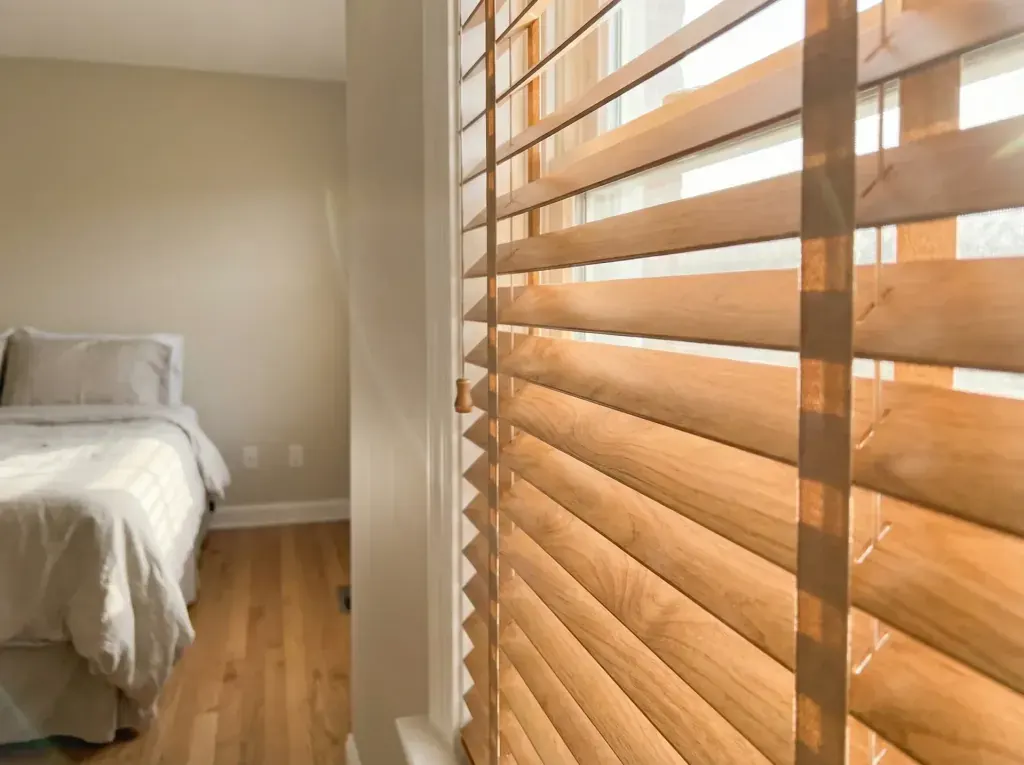
Nobody thinks about weight when picking out a wood blind, until they own one they can barely lift. A wide blind in the wrong material turns into a chore within a year, and it's almost always avoidable. Here is how slat size and material interact with width limits on a Fishers window, and what to ask for before you order.
Real Wood or Faux Wood: How to Choose
Choosing between real wood and faux wood blinds isn't really a style decision, even though it gets treated like one in most showrooms. Basswood, the standard real wood option, is light, straight grained, and takes stain evenly; it weighs about half of what a same sized solid vinyl slat weighs, which becomes a real factor on a wide window. Faux wood splits into two different products under one name: solid PVC, heavy and cheap to start with, and composite, which wraps a wood-polymer blend in a painted finish and lands in between on both weight and cost.
The right pick depends on what the window is exposed to, not on which one photographs better. A dry Fishers room favors basswood, since wood absorbs and releases moisture and will cup or twist if it doesn't stay dry. A humid room, whether that's a kitchen window over the sink or a bathroom that steams up daily, favors faux wood or composite instead, since neither one moves with humidity the way real wood does.
Measuring, Mounting and Finishing Details
Here's the measuring mistake that causes the most callbacks: skipping the square check on an older opening. A window that's a quarter inch narrower at the bottom than the top will bind a blind cut to a single number, so it drags on one side and never sits flush no matter how carefully it was hung. Measuring width and height in three places each catches that before the order goes in, not after. Mounting depth is the other one: a 2 inch headrail needs roughly two to two and a half inches of flat depth for a flush inside mount, and shallow trim without that depth leaves the headrail sitting proud of the frame.
Route less slats fix a specific and very visible problem in the wrong room: a standard blind's ladder holes line up into a column of light dots at night against a streetlight, and in a Fishers bedroom that faces one, people notice it every night until it's fixed. On a door, skipping hold down brackets is the other common miss, since the blind needs to swing with the door without banging into the frame or the handle.
Cost, Lift Choices and What Drives the Price
As a national range, stock blinds from a home center run roughly $60 to $600 a window, a sensible buy for a rental or a basement window and nothing to feel bad about. Nationally, custom blinds, measured in the home and installed, run roughly $250 to $2,600 a window, with the range driven by material, from solid PVC through composite to premium stained basswood, along with slat size and whether the slats are route less.
Lift adds its own cost on top of that. Corded is the base price, needing a tensioner fastened to the wall. Cordless and motorized both cost more; cordless carries weight limits on wider blinds, while motorized is usually the single biggest line on a quote, with battery powered motors nationally running roughly $100 to $300 a window less than hardwired versions. Custom orders typically take two to five weeks to fabricate, so there's rarely a reason to rush the decision.
Choose material by room, not by price sheet: faux wood or composite anywhere there's steam or splash, basswood where the room stays dry. Let width and weight decide the lift after that. Fishers Window Treatments measures every opening and checks it for square before an order goes in. Call (317) 863-9966 for real numbers on your Fishers windows.
Weight, Slat Size and Width Limits
Slat size is a proportion decision as much as a functional one. Two inch is the default for most windows, but bigger slats mean fewer of them, so there's more open glass showing when the blind is tilted and less visual clutter across the view. The tradeoff shows up on a short window: bigger slats stack deeper when raised, and that stack can cover a real slice of the glass, which is why a 1 inch slat sometimes wins on a small bathroom or kitchen window where a wider slat would look heavy.
Weight enters the picture on wide windows specifically. A large faux wood blind gets heavy fast, and past a certain width the headrail needs a center support bracket just to stay straight in the middle. On a wide Fishers living room window, splitting the opening into two blinds on one shared headrail solves the weight problem while keeping the top line looking unbroken, since a single valance still runs the full width even though two separate blinds do the tilting underneath it.
Where Wood Blinds Fit Best Room by Room
Room fit changes what a wood blind is actually worth to you, which matters when you're deciding where to spend. In a living or dining room, basswood earns its higher price, since the room stays dry and the slat is on display as part of the trim every day. Spending up on real wood over a kitchen sink, by contrast, is one of the more common ways people waste money in this category, because that window will cup a slat within a couple of seasons regardless of quality.
Kitchens and bathrooms are better served by faux wood or composite, which cost less than premium basswood anyway and hold up to steam and splash without complaint. Bedrooms are where a smaller upgrade pays off: route less slats, which remove the ladder holes from the face of each slat, cost more than standard routed slats but solve the column of light dots that shows up at night against a streetlight. In a Fishers hallway nobody sleeps in, that upcharge isn't worth paying.
Frequently Asked Questions
What are route-less blinds and are they worth the upcharge?
A standard blind has a hole punched through every slat for the ladder string. Closed at night, those holes line up into a column of small light dots. Route-less slats put the ladder in a notch at the back edge instead, so the face of the slat has no hole. They cost more, and the ladder shows from behind. Slats can also shift slightly side to side. In a bedroom facing a streetlight they are worth it. Elsewhere, usually not.
Can wood blinds be cordless if we have young kids?
Yes, and cordless lift with a wand tilt is what we would put in any house with children or pets. Ask for cordless product built to ANSI/WCMA A100.1-2022, which is the product safety standard covering how these are made. The one catch is weight. Cordless mechanisms are springs with published limits, so a very wide faux wood blind may not be offered cordless at all, which pushes you toward splitting it or motorizing it.
How do I clean wood blinds properly?
Dust regularly with a dry microfiber cloth or a vacuum brush on low suction, closing the slats one way, wiping, then closing them the other way. Faux wood and composite tolerate a damp cloth with mild soap. Real wood should never be soaked, since water raises the grain and can cup a slat. Skip the furniture polish, which builds up a film that grabs dust and gums up the ladder strings over time.
 Window Treatments in Fishers: A Complete Buyer's Guide
 Common Plantation Shutter Mistakes Fishers Homeowners Should Skip
 Motorized or Manual: Choosing Shades for a Bay or Bow Window