Motorized or Manual: Choosing Shades for a Bay or Bow Window
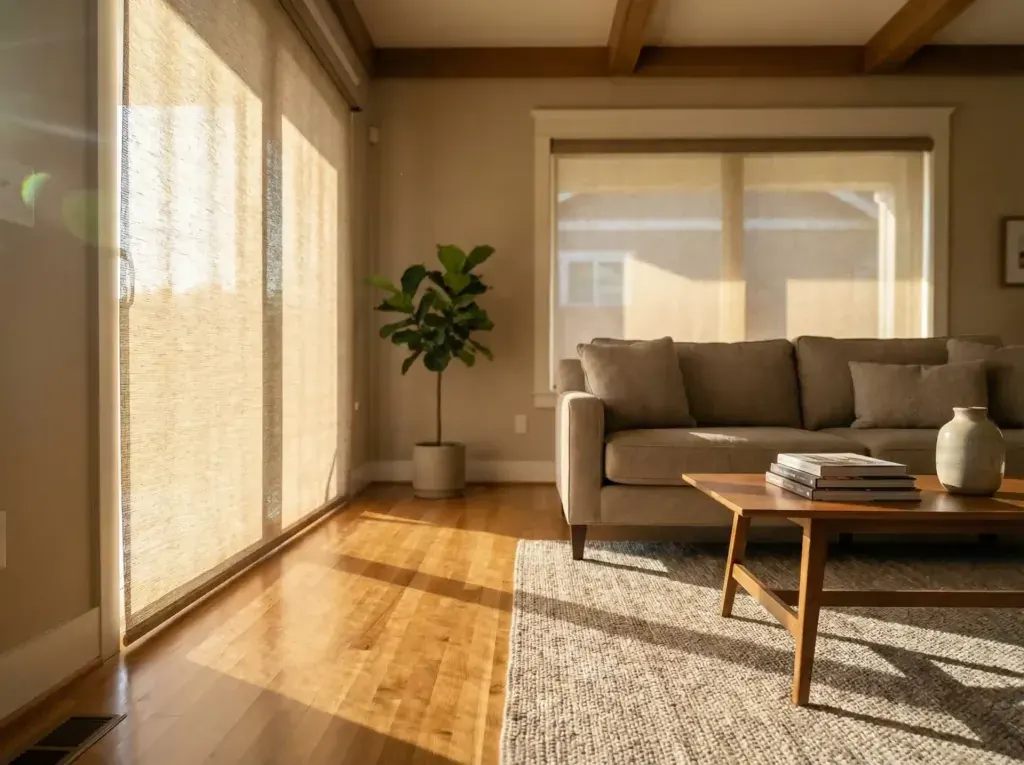
Bay and bow windows bring in more light and more glass than a standard window, which is exactly why they're popular and exactly why they trip people up once it's time to actually cover them.
Why Bay and Bow Windows Need a Different Approach
Think of a bay window as three control zones instead of one window, and a bow window as four to six, because that's closer to how they actually behave once shades are installed. Each angled or curved unit catches light differently through the day, which is exactly why treating the whole bay as a single technical project, rather than a single style choice, tends to produce a better result.
A typical bay window sets two angled side units, usually 30 or 45 degrees, around a center window that's often fixed and non-operating. A bow window curves that arrangement across more panes at gentler angles. How you end up controlling the shades matters more here than on a standard window, since you're deciding for several units at once instead of just one.
Homeowners in Fishers planning a bay or bow treatment usually come in focused on fabric and end up spending just as much time on the control side once they see how the units interact through the day.
Choosing How to Operate Multiple Shades at Once
Motorization is optional, and treating it that way is one of the easiest ways to manage a bay window budget without giving up much function. Cordless manual lift, the kind with a spring mechanism or a bottom-up pull, costs less than motorized lift and still removes the loose cord that's the biggest daily annoyance on a bay window.
If motorization matters for one unit, usually the one hardest to reach behind a window seat, it's reasonable to motorize just that one and leave the other two or three on cordless manual lift. That approach keeps most of the convenience while keeping most of the budget intact.
Grouping controls, whether manual pulls tied together with a connector rod or motorized units on a shared remote channel, is worth asking about too. It's a small add that keeps three shades moving together instead of three people in the house operating them three different ways.
Matching Shade Styles to Each Angle of the Bay
This is where the three-windows problem usually gets fixed or made worse. The fastest way to make a bay window in Fishers look intentional is to use the same shade style and the same fabric across every unit in it, including the center window if it operates independently. Consistency reads as design. Variety reads as an afterthought.
Roller shades and cellular shades tend to work well here because their headrails are slim and low-profile, so the line across the top of the bay stays clean and continuous even where the wall angles change direction. A roman shade can absolutely work on a bay, but the folded fabric at the top adds bulk right at the corners, which can break that clean line.
If the center window is meaningfully wider than the sides, as it often is, you don't have to match the exact width proportions, just the fabric and the mounting style. A wider version of that same shade in the center still reads as one design decision, where a different product entirely would not.
What Bay and Bow Window Shades Typically Cost
The budgeting mistake we see most is pricing a bay window treatment like one large window instead of pricing each unit on its own. As a general national range, not a specific quote, a mid-grade cellular or roller shade typically runs $150 to $400 per window, and a bay or bow window simply has more windows than a standard opening, so cost adds up unit by unit rather than averaging down.
Skipping that math ahead of time, and assuming a three-window bay should land near the price of one large window, is how people end up surprised by a quote that was actually reasonable for what it included.
The other cost mistake is assuming motorization has to go on every unit or none at all. Motorizing just the hardest-to-reach unit, often the one behind a window seat, and leaving the other two on a simple cordless lift is a common middle ground that keeps the budget in check. A free in-home measure will tell you exactly where your numbers land instead of guessing from a general range.
A real number for your bay or bow window beats a general range every time, and the only way to get one is to have someone measure the actual angles and depth involved, glass and all. A free in-home measure covers exactly that, with no obligation attached. Call (317) 863-9966 whenever you're ready to get one on the calendar.
Getting an Accurate Measurement on a Multi-Angle Window
Here's a habit that saves people real money: measure every opening separately, even when the plans say they're identical. Older platted neighborhoods around Fishers were framed by hand, and it's common to find a bay where the two side windows are off by a quarter inch to half an inch, enough to leave a shade sized off one opening sitting crooked in the other.
Check the width near the top of each frame, then again near the bottom, and look at the middle if the opening seems out of square. Do the same for height on both sides. When the numbers don't match within about an eighth of an inch, order to the smaller measurement so the shade actually clears the frame.
Depth matters just as much as width. Inside-mount cellular or roller shades generally need 2 to 2.5 inches of clear space once you account for a crank handle or window lock. Measure with the window closed and the hardware sitting where it normally sits, since that's how it'll be every day once the shades go up.
Frequently Asked Questions
Do all three windows in a bay need to match?
They don't have to be identical, but keeping the fabric and the mounting style the same across all the units is what makes the bay read as one treatment instead of three separate ones. The center window can be a wider version of the same shade rather than a completely different product.
Can I use the same shade style on a bow window as a bay window?
Usually, yes, and bow windows actually give you more flexibility since the angles between units are gentler than a standard 30 or 45 degree bay. Roller and cellular shades work well on both, while bulkier styles like roman shades have an easier time clearing the wider curves of a bow than the tighter corners of a bay.
How long does it take to get shades for a bay window once they're ordered?
It varies by product and fabric, since a bay or bow order involves multiple custom-cut units instead of one. Whoever measures your window can walk you through the timeline for the specific products you're considering.
 Window Treatments in Fishers: A Complete Buyer's Guide
 Common Plantation Shutter Mistakes Fishers Homeowners Should Skip
 Why Wood Blinds Fail in Bathrooms and Kitchens (and What Doesn't)