Measuring Windows Yourself in Fishers: What to Get Right and What to Skip
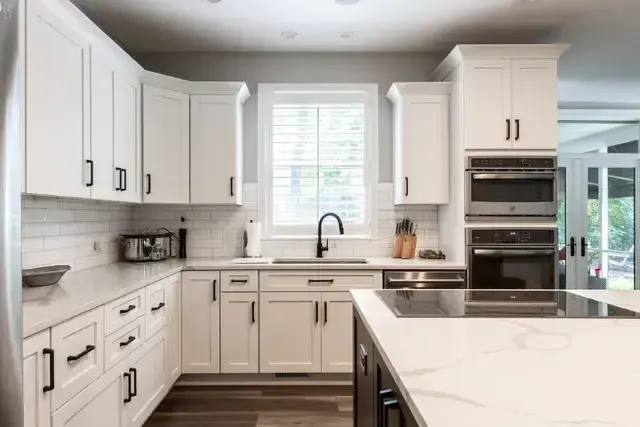
Measuring a window sounds like it should take thirty seconds: width, height, done. It doesn't work that way for custom product, and the gap between a rough number and an order-ready number is exactly where most DIY mistakes happen.
Deciding Inside or Outside Mount Before You Measure
Before deciding whether to measure it yourself, decide the mount, because that choice affects how much margin for error you actually have. Inside mount depends on exact frame depth and a clean, obstruction-free opening. Outside mount is more forgiving, since it's built around coverage rather than fitting precisely inside a fixed space.
If a window clearly has generous depth, no crank or lock in the way, and a level sill, inside mount is likely on the table and the measurement is fairly straightforward. If any of those things are questionable, outside mount is either the answer already or worth strongly considering, and it happens to be the easier of the two to measure accurately as a first-timer.
This is worth sorting out on a Fishers home before deciding how much of the measuring to tackle solo, since a straightforward outside mount job is a very different undertaking than a tight inside mount fit with obstructions to navigate around.
Recording the Numbers Without Wrecking the Order
With a full house of windows to get through, the recording system matters as much as the measuring itself. Round to the nearest eighth of an inch. Write width first, then height. Label every single entry by room and window position, such as kitchen over sink rather than just kitchen, if there's more than one window in that room.
Take a photo of each window with its numbers visible on a sticky note or written on painter's tape stuck to the frame. It takes ten extra seconds per window and it's the easiest way to catch a transcription error before you're filling out an order form for the whole house at once, days later, from memory and a notepad.
Double check the total count at the end. It sounds obvious, but it's an easy step to skip, and a missed window is a common way a full-house order comes up one item short.
What Happens When the Measurement Is Wrong
This is the part worth being straight about. Custom window coverings are built to the exact number you provide, and once they're cut and assembled, they generally can't be returned the way a stock item can. If the number's off by enough to matter, you're looking at paying for a remake rather than getting a refund, since the mistake was in the measurement, not the product.
That doesn't mean measuring your own windows is a bad idea. Plenty of Fishers homeowners do it successfully every year, especially on straightforward rectangular windows with clear access and no obstructions. Where it gets risky is on anything unusual: a window with visible slope, one where you're not sure if there's clearance for inside mount, or a room with enough windows that one bad measurement is easy to lose track of among the rest.
If you've gone through the process and you're confident in the numbers, that confidence is usually earned and worth trusting. If something about a specific window feels uncertain, that's exactly the situation a second set of eyes is good for, and it costs nothing to have someone check before an order that can't be undone goes in.
Measuring your own windows is a reasonable thing to attempt, as long as you go in knowing a custom order can't be undone if the number's off. If any part of the process feels uncertain, a free in-home measure is there to double check the work before you order.
The Three-Point Measure, and Why One Number Isn't Enough
This is the step that separates a careful DIY measurement from a rushed one. Measure width at the top, the middle, and the bottom of the opening. Measure height at the left, the middle, and the right. Write down all six numbers, not an average and not just the middle reading.
The reason is simple: very few window frames are perfectly square, even in newer Fishers construction. A frame can look dead straight and still be a quarter inch narrower at the top than the bottom. The order gets built to the smallest width of the three and the smallest height of the three, because a shade sized to the largest measurement won't fit into the tightest point of the actual opening.
Skipping this step is the single most common shortcut in a DIY measure, and it's understandable, since measuring once in the middle feels thorough enough. On plenty of windows it is. On enough of them it isn't, and there's no way to know which category a given window falls into without actually checking all three points.
The Tools That Actually Matter
A cloth tape measure is where a lot of bad numbers start. It stretches with age, sometimes enough to throw off a measurement by a noticeable margin on an older tape that's been sitting in a drawer for years. A cheap steel tape from any hardware store solves this completely and there's no excuse to skip it.
The phone's notes app is another quiet source of errors. It's easy to fat-finger a digit while typing one-handed off a ladder, and unlike a handwritten note, a typo in an app doesn't visually stand out the way a smudged pencil correction does. Paper and pencil, written clearly, beats it every time for this specific job.
Working alone on a wide window is its own risk. A tape held at one end and read at the other tends to sag in the middle without a second hand holding it taut, which quietly adds a false half inch or more to the reading. Get help for anything beyond a narrow window.
Frequently Asked Questions
Should I measure to the nearest inch or the nearest fraction?
Nearest eighth of an inch, every time. Rounding to the nearest inch feels close enough but it isn't, since a quarter inch of slop is often the difference between a shade that fits and one that doesn't clear the frame or leaves a visible gap.
What kind of tape measure should I use?
A steel tape, not a cloth one. Cloth tapes stretch slightly with use and age, which throws off a measurement just enough to matter on a custom order. A basic steel tape from any hardware store is accurate and cheap.
Do I measure the glass or the whole frame?
Neither, exactly. For inside mount you measure the inside of the frame opening itself, not the glass and not the outer trim. For outside mount you're measuring how far past the frame you want the covering to extend, which is a different number entirely.
 Window Treatments in Fishers: A Complete Buyer's Guide
 Common Plantation Shutter Mistakes Fishers Homeowners Should Skip
 Motorized or Manual: Choosing Shades for a Bay or Bow Window