Picking Drapery Colors That Work With Fishers Light
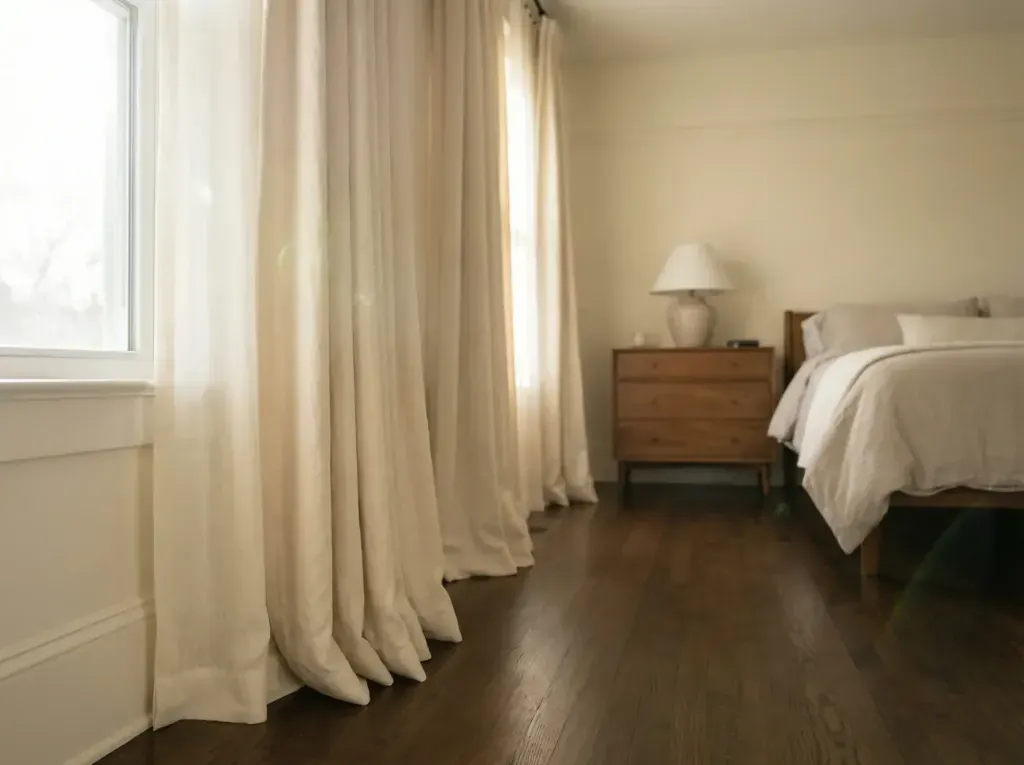
Walk into a handful of Fishers living rooms and you will see just as many reasons a particular fabric and color got chosen, some good, some based on a swatch that never got tested against the actual window. There is a fair amount of trade knowledge behind a decision that looks simple from the outside.
Fabric Weight and How Drapery Falls
Heavier fabric usually costs more per yard, and it's tempting to assume that means better. It doesn't always. What you're actually paying for with weight is drape and durability. A heavy fabric holds its pleat shape for years and doesn't need re-pressing, while a cheap lightweight poly can look tired within a couple of seasons even if nobody's touched it. If the budget is tight, spending on weight in the main living room and going lighter in a guest bedroom is a reasonable way to split the difference.
Where Fishers homeowners get surprised is hardware cost. A heavy interlined panel on a wide window needs a rod built to carry that load, and an underrated rod is the single most common reason a beautiful fabric ends up sagging in the middle within a year. That's not a fabric problem, it's a mismatch between weight and support.
Lightweight fabric isn't automatically the cheap option either. Sheers and voiles often need more fullness to look right, which means more yardage, so the fabric itself can end up costing close to what a mid-weight solid would.
Pattern and Texture
Look at what's already patterned in the room before adding more pattern at the window. A room with a patterned rug and patterned upholstery generally needs a solid or textured drapery, otherwise everything competes for attention and the room feels busy rather than layered. A mostly neutral room, on the other hand, has room for the window to be the pattern statement.
Scale should relate to the size of the window and the room, not just personal preference. A tight, repeating small print can look almost like a solid from across the room, which works well in a smaller Fishers bedroom where a huge bold pattern would feel like too much. A great room with high ceilings and a big expanse of glass can carry a much larger scale print without it feeling overdone.
Texture is worth leaning on in rooms that already have a lot of hard, smooth surfaces, tile floors and large expanses of glass, for instance. A slubby linen or a nubby weave softens a room like that in a way a flat, smooth solid fabric doesn't.
Fullness and the Hardware Behind It
A rod that isn't rated for the actual weight hanging on it is the single most common hardware failure we see. It happens when someone orders a decorative rod based on how it looks rather than its load rating, then hangs a fully lined, high-fullness panel on it. Within months, the middle of the rod starts to dip and the rings drag instead of gliding, so the panels never hang quite straight again.
Center support brackets get skipped too often on wide spans. Anything much past six feet of rod, especially carrying a heavy panel, needs a support in the middle, not just brackets at each end. Skipping it to save a small amount on hardware is one of the more common regrets we hear about a year or two after installation.
We've also seen fullness ordered based on a general rule of thumb without checking it against the specific fabric weight. A heavy fabric at very high fullness can be almost too bulky to open and close smoothly on a Fishers window, stacking into a thick bundle that eats up more wall space than expected once the panels are pushed open.
The best way to settle a fabric or color decision is to see real samples against your actual window, not a swatch card under artificial light. A free in-home measure gives you that chance, along with a second set of eyes on what the room and the sun exposure actually call for.
Color and Sun Exposure
Ask the fabric supplier directly whether the color is solution-dyed or piece-dyed. Solution-dyed means the color is mixed into the fiber before it's even spun into thread, which holds up to sun much longer. Piece-dyed means the color is applied to the finished woven fabric, which usually looks and feels nicer but tends to fade faster under strong light.
Ask what fiber content the fabric actually is, not just the color and pattern name. A "linen-look" fabric might be entirely polyester, which fades slower than real linen but drapes differently and doesn't breathe the same way. Neither is wrong, but you want to know which one you're buying.
And ask about the specific exposure of your window before locking in a color, not after. A west-facing Fishers window with several hours of direct summer sun is a different conversation than a shaded north window, and a good measure appointment should include someone actually asking which direction the window faces before making a fiber recommendation.
Light Control and Lining Options
Lining does two main jobs: it controls how much light comes through, and it protects the face fabric from daily sun on the back side. It also gives the panel a cleaner look from the street, since passersby otherwise see the underside of the fabric's seams. Standard cotton sateen lining knocks down glare and adds a bit of privacy without going fully dark.
Blackout lining is a different animal, usually a foam-coated or knit-backed layer bonded to the lining that blocks nearly all direct light through the fabric itself. The word "nearly" matters. Drapery isn't built into a sealed track the way a cellular shade is, so even a true blackout panel lets a strip of light leak in around the edges and at the top where the rod sits.
If a bedroom needs the room fully dark, we usually pair blackout drapery with a shade mounted inside the window frame behind it, rather than relying on the drapery panel alone to seal the room. For most Fishers living rooms, a middle-weight lining is the right call, enough body and light control without turning the room into a cave.
Frequently Asked Questions
What is the difference between blackout lining and regular lining?
Regular lining, usually a cotton sateen, adds body and cuts down glare without blocking much light. Blackout lining has a foam-coated or tightly woven layer bonded to it that blocks nearly all direct light through the fabric itself, though some light still leaks around the edges and top of the panel since drapery is not a sealed system the way a shade in a track is.
Why did my curtain color look different once it was installed?
Almost always it is the lighting. Showroom fluorescent lighting and a home's actual daylight render color very differently, and a swatch that looked warm and creamy in the store can look cooler or flatter once it is hanging in a room with different light exposure. Testing a sample against the real window at different times of day avoids most of this surprise.
Is a more expensive fabric always the better choice?
Not automatically. Price often reflects fiber content and how the fabric was dyed, both of which affect drape and how long color holds, but a well-chosen mid-range fabric at the right fullness and with good lining can outperform an expensive fabric that is skimped on those details. Weight and construction usually matter more than the price tag alone.
 Window Treatments in Fishers: A Complete Buyer's Guide
 Common Plantation Shutter Mistakes Fishers Homeowners Should Skip
 Motorized or Manual: Choosing Shades for a Bay or Bow Window